An honest analysis of Odoo pricing in 2026, with the official rates verified on odoo.com in June 2026. You will see the licence tiers, their real per-user cost with VAT, what each plan includes, the total cost almost nobody calculates (partner implementation, hosting and training) and a transparent comparison with three alternatives by profile.
Odoo was born in 2005 in Belgium as TinyERP and is today one of the most widely used modular ERPs in the world, with more than 12 million users. Its catalogue runs to over 40 integrable apps: CRM, accounting, inventory, manufacturing e-commerce, HR, projects. It is powerful and highly configurable. It is also, by a wide margin, the most complex tool in this comparison series. Its pricing model reflects that difference: Odoo charges per user, not a flat plan, so the cost scales with every employee who needs access. And the licence price is only one part of the real cost of getting it running in Spain.
The 30-second verdict
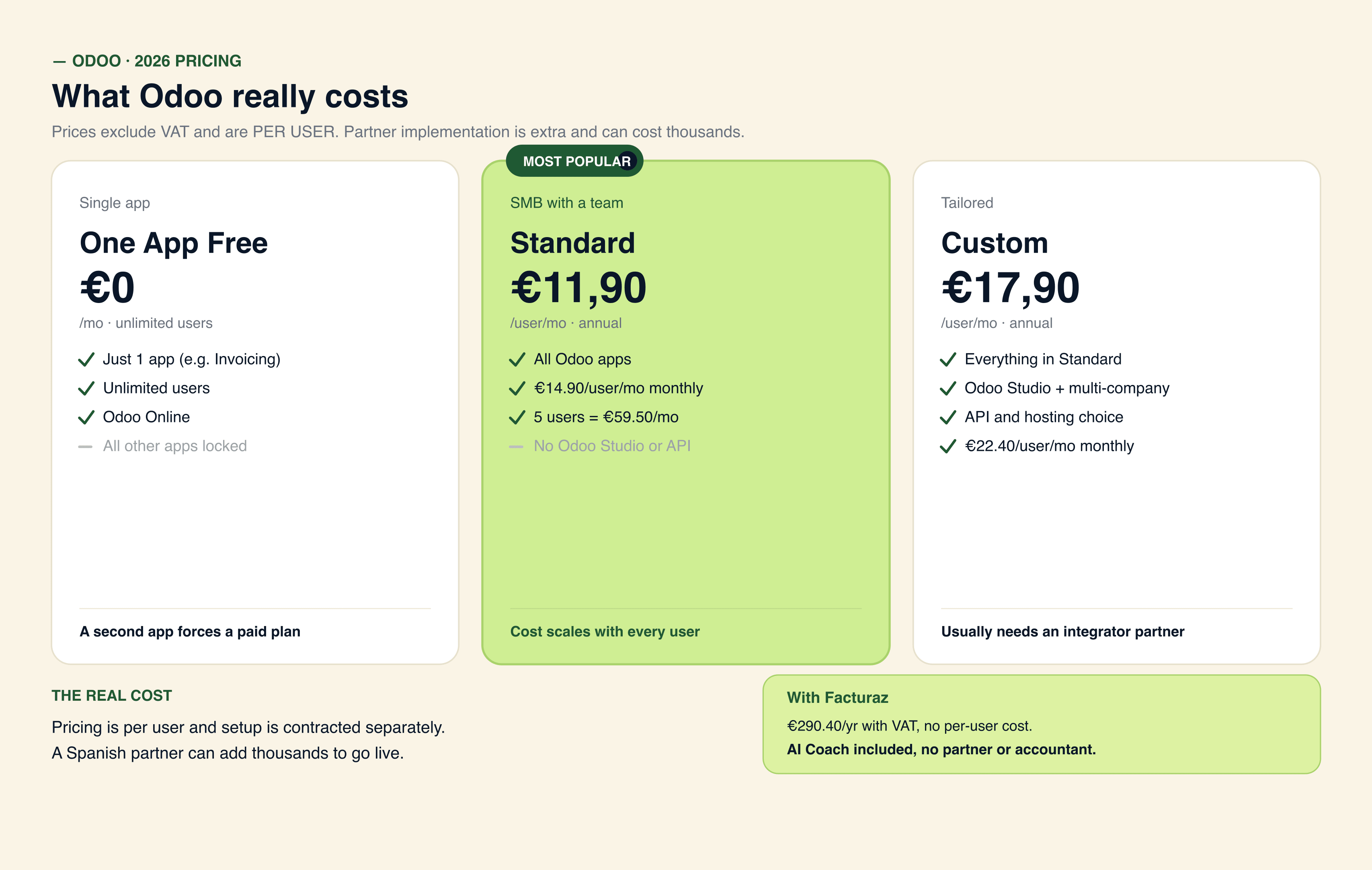
Odoo has three tiers (prices excl. VAT, annual billing): One App Free €0 (a single app, unlimited users), Standard €11.90/user/mo and Custom €17.90/user/mo. On monthly billing these rise to €14.90 and €22.40 per user. It is a very powerful ERP, but the price is per user and the cost climbs sharply once you add the implementation, which in Spain usually requires an integrator partner (potentially thousands of euros on top of the licence).
Odoo wins for SMEs with an in-house technical team or partner, complex processes and a need for deep customization. If you are a freelancer or a business of up to 10 employees that only wants to invoice and stay compliant with the tax authority without an implementation project, Odoo is too big for you. Read on for the real total cost and an alternative that goes the opposite way.
How much does Odoo cost in 2026?
Odoo has three licence tiers, billable monthly or annually. With annual billing the per-user price drops by around 20%. These are the official prices excluding VAT, verified on odoo.com in June 2026:
| Plan | Annual (€/user/mo) | Monthly (€/user/mo) | Apps included | Users |
|---|---|---|---|---|
| One App Free | €0 | €0 | 1 app only | Unlimited |
| Standard | €11.90 | €14.90 | All | Per user |
| Custom | €17.90 | €22.40 | All + Studio + API | Per user |
Prices excl. VAT, verified on odoo.com in June 2026. Annual billing applies roughly a 20% discount versus monthly. The price is per user, so the cost of Standard and Custom multiplies with every employee who has access to the system.
The per-user model is the underlying difference with most Spanish competitors. Holded, Anfix and Facturaz use a flat plan (one price for your business). Odoo scales the cost with every employee who needs to log in. An SME with 5 users on the annual Standard plan pays €59.50/mo excl. VAT (5 × €11.90), that is €714/yr excl. VAT and €863.94 incl. VAT. On monthly billing the same setup rises to €74.50/mo.
And here is the detail almost nobody sees before signing up: the licence cost is only one part of the real total cost. To run Odoo in production with Spanish localization and Verifactu compliance, the norm is to hire an integrator partner (implementation cost on top, often thousands of euros), choose hosting and train the team. We break it down below.
What each plan includes
One App Free (€0). A permanent plan with a single free app (for example only Invoicing, or only Accounting, or only CRM) and unlimited users, on Odoo Online. The critical limitation: the moment you need a second app, you move automatically to the per-user Standard plan. If you start with free Invoicing and later want to add CRM, the cost jumps to €11.90/user/mo (annual) for the whole team.
Standard (€11.90/user/mo on annual billing). The recommended plan for SMEs with standard processes. It includes all apps, Odoo Online hosting, automatic updates, standard support and Spanish localization. It does not include Odoo Studio (the no-code customization), the external API, native multi-company or hosting choice.
Custom (€17.90/user/mo on annual billing). The complete plan. It adds Odoo Studio to customize without programming, the external API for integrations, native multi-company and the option to choose hosting (including Odoo.sh or your own server). It is the plan for SMEs with complex processes, multiple companies or technical integrations.
A note on Odoo Community, the open-source version: it exists and is free of licence, but it is not a fourth plug-and-play plan. It requires your own server, devops, a developer and maintenance on your side and the Spanish localization depends on community modules whose quality varies. For an SME without a technical team, Community is not a realistic option, so in this comparison we focus on the paid Online plans.
The real annualized cost with VAT
The website prices exclude VAT and are per user. To know what you really pay, you have to add the 21% and multiply by the number of users. This is the real annual cost per user and for a team of 5, on annual billing:
| Scenario | Standard (incl. VAT) | Custom (incl. VAT) |
|---|---|---|
| 1 user / year | €172.85/yr | €259.93/yr |
| 5 users / year | €863.94/yr | €1,299.66/yr |
| 10 users / year | €1,727.88/yr | €2,599.32/yr |
21% VAT included, annual billing. One Standard user is €11.90/mo excl. VAT, that is €142.80/yr excl. VAT and €172.85 incl. VAT. The cost grows linearly with each user, unlike the flat plans of Holded, Anfix or Facturaz.
And here is the calculation almost nobody does. The licence is not the real total cost. For a typical Spanish SME of 5 users that wants Odoo running in production, year 1 usually adds several blocks on top of the licence:
| Item (5 users, year 1) | Estimated cost |
|---|---|
| Standard licences (5 × €11.90 × 12, annual billing) | €714/yr excl. VAT |
| Implementation with a certified partner (one-off) | €2,000 to €30,000 |
| Verifactu setup and localization | €500 to €3,000 (usually bundled into the implementation) |
| Team training (40 to 80 hours) | €1,500 to €4,000 |
| Estimated year 1 total | €4,700 to €37,000+ |
| Year 2 total (no implementation) | €714 to €4,000/yr |
Estimates based on official partner ranges in Spain (June 2026). The range is wide because it depends on the number of modules, the customization and the size of the implementation. Always confirm the quote with a certified partner for your specific case.
This is not a flaw in Odoo, it is the nature of a modular ERP. For complex processes, that power justifies the cost. But it pays to calculate the whole thing before choosing. For comparison, Facturaz costs €24/mo (€240/yr excl. VAT with 2 months free on annual billing, €290.40 incl. VAT), with no partner or implementation and multi-user access included in the plan. A 5-employee SME gets the same price.
Quick comparison with alternatives
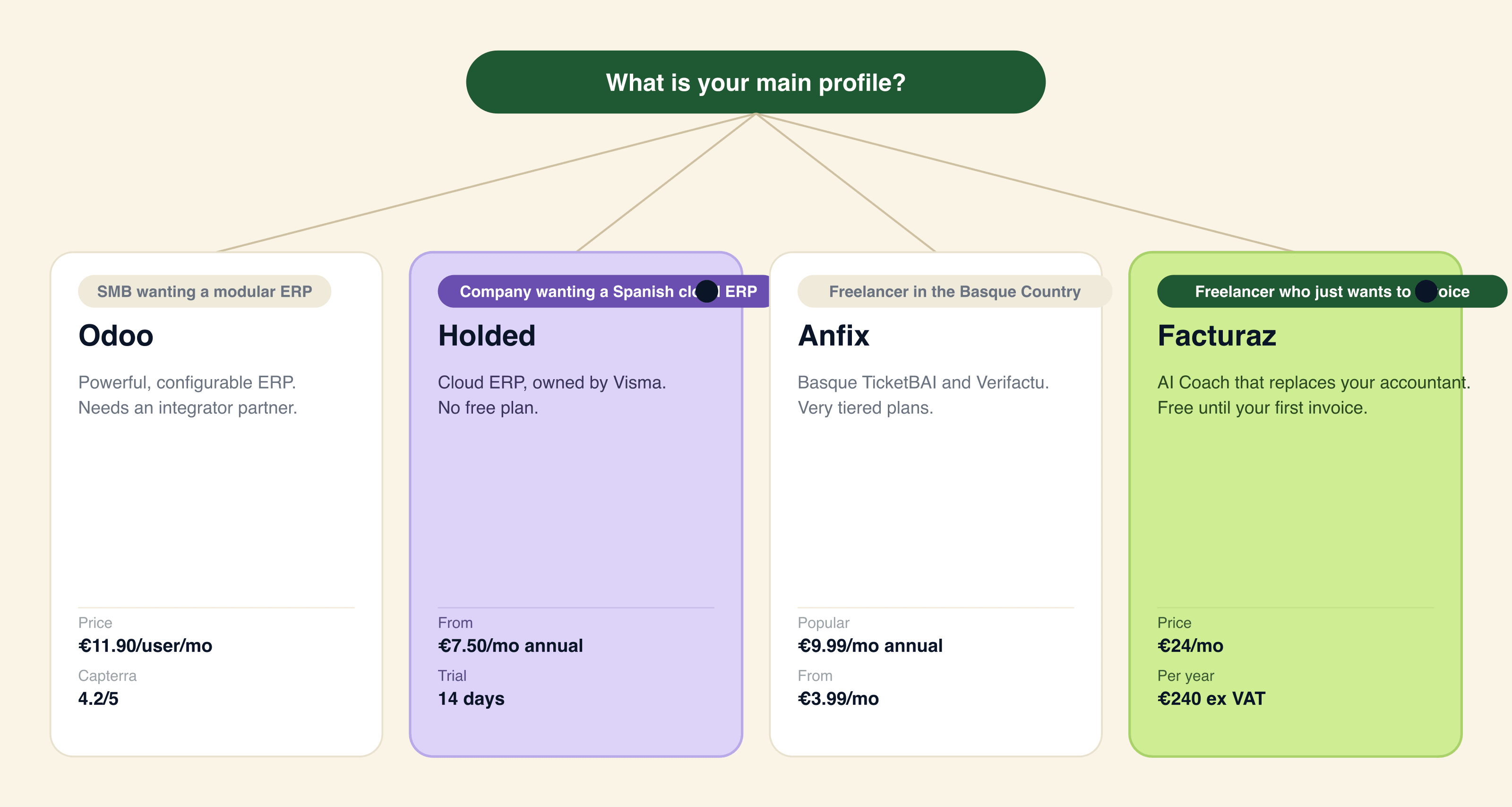
Here is how Odoo compares with three relevant alternatives. To keep it fair, for each tool we use the plan recommended for its profile, on annual billing.
| Criterion | Odoo Standard | Holded | Anfix | Facturaz |
|---|---|---|---|---|
| Recommended price (€/mo, annual, excl. VAT) | 11.90 per user | 15 (Plus) | 9.99 (Avanzado) | 24 |
| For 5 users, annual incl. VAT | €864/yr | from €217/yr (Plus) | €145/yr (up to 2 users) | €290/yr (multi-user included) |
| Per-user pricing | Yes (scales with the team) | No (flat plan) | No (flat plan) | No (flat plan) |
| Implementation included | No (€2,000 to €30,000 with a partner) | Yes (self-service) | Yes (self-service) | Yes (self-service) |
| Learning curve | Very high | Medium-high | Medium | Zero (premise) |
| Verifactu-compliant | Yes (with localization configured) | Yes | Yes | Yes |
| Proactive AI (anticipates problems) | No | No | No | Yes (AI Coach) |
| Designed for | Technical SME with IT or a partner | SME 5-30 with ERP or e-commerce | Freelancer with an accountant (also foral) | Freelancer and SME 0-10 without a technical team |
Prices verified in June 2026 on the official websites. Odoo's cost does not include the implementation, which for a Spanish SME is usually mandatory. Each tool has a different ideal profile.
What is NOT included in the price
These are the costs and limits worth being clear about before signing up.
- Implementation with a certified partner. From €2,000 to €30,000 depending on complexity. Without a partner, configuring Odoo for a real Spanish business (with Verifactu, the correct tax forms and localization) is very hard without a technical background.
- Team training. The learning curve is steep. The norm is to invest 40 to 80 hours of external training (€1,500 to €4,000) so the team can operate without constant help.
- Per-user cost. Standard and Custom are charged for every employee with access. Five Standard users on annual billing are €59.50/mo excl. VAT; ten users, double that.
- Odoo Studio and multi-company only on Custom. No-code customization, the external API and multi-company management are reserved for the Custom plan (€17.90/user/mo annual).
- Jumping off the free plan. One App Free stops being free the moment you need a second app. At that point you move to per-user pricing for the whole team.
- Verifactu requires configuration. Compliance (RD 1007/2023, amended by RD 254/2025) requires a properly configured localization. In practice, a certified partner.
- No proactive AI. Odoo is a very powerful operational ERP, but it does not include an assistant that anticipates tax problems or suggests deductions on its own.
Implementation and partners
Unlike cloud-first products like Holded or Facturaz, Odoo normally requires professional implementation. Odoo maintains a network of certified official partners in Spain. The typical ranges verified in June 2026:
- Basic implementation (1 to 3 modules, no customization): €2,000 to €5,000.
- Intermediate implementation (5 to 8 modules with tax configuration): €5,000 to €15,000.
- Complex implementation (multi-company, manufacturing, customization): €15,000 to €50,000 or more.
The typical time from kick-off to having Odoo operational runs from 1 to 3 months for simple cases and from 3 to 12 months for complex ones. Self-implementation is possible with Community and your own IT team, but it requires real technical knowledge (Python, PostgreSQL, devops). It is not an option for a solo freelancer or an SME without a technical team.
Who Odoo is worth it for
Odoo fits especially well for profiles where its power and flexibility hit the mark:
- SMEs with an in-house IT team or technical partner. If you have an internal developer or already work with an Odoo consultancy, the implementation overhead pays off through the functional power.
- SMEs with complex or industrial processes. Real manufacturing with planning, advanced multi-warehouse e-commerce with thousands of SKUs.
- Businesses that need deep customization. Odoo Studio plus the API allow tailor-made processes that no closed ERP can match.
- Multi-company or multi-country SMEs. The Custom plan includes native multi-company with multi-currency support.
- Businesses that value open source. Community is open source. For those who want code ownership and freedom from the vendor, Odoo is almost unique in its category.
Who Odoo is NOT worth it for
Odoo is not the optimal choice if your profile is away from an ERP project:
- You are a solo freelancer without a technical team. The learning curve is very steep and the real total cost is very high versus tools built for freelancers.
- Your business does not need deep customization. You are paying for flexibility you will not use. Holded or Facturaz cover standard needs at a much lower real cost.
- Your total budget is limited. If €5,000 to €10,000 in year 1 is a problem, Odoo is not viable. Alternatives: Holded, Anfix or Facturaz.
- You need to be operational in under a month. Typical implementation runs from 1 to 6 months. Cloud-first tools are operational in hours.
- You want an AI that anticipates tax problems. Odoo is very powerful operationally, but it does not include a proactive AI Coach. For that, Facturaz is the option in the freelancer and SME 0-10 segment in 2026.
- Your business has 10 employees or fewer with standard operations. A full ERP is oversized. Holded or Facturaz cover what you need at a much lower real cost.
Alternatives by profile
Three options that cover the profiles where Odoo is not the optimal choice.
Holded, for SMEs that want a cloud ERP without a complex implementation
Holded, from €15/mo on the Plus plan (€7.50 with the annual discount). A full cloud ERP (invoicing, accounting, CRM, inventory, HR and projects), owned by Visma. It is the most direct cloud alternative to Odoo for Spanish SMEs: self-service implementation, operational in days instead of months, native integrations with Shopify and WooCommerce. Choose it over Odoo if you have no IT team or partner, your processes are standard and you want to avoid the implementation project. It has no free plan (14-day trial).
Anfix, for freelancers who work with an accounting firm
Anfix, from €3.99/mo (€9.99/mo for the Avanzado plan on annual billing, the most popular). Spanish cloud software with more than 15 years on the market, designed to collaborate with your accounting firm in real time. It is also one of the few tools certified for TicketBAI in the three Basque foral territories, on top of being Verifactu-compliant in common territory. Choose it over Odoo if you are a freelancer, work with an external accountant and do not need a full ERP. Its cost is flat, not per user.
Facturaz, for freelancers and SMEs 0-10 who want proactive AI without the complexity of an ERP
Facturaz, free until your first invoice and €24/mo after that. An AI CFO for freelancers and businesses with up to 10 employees. Here is the underlying contrast with Odoo: the two products serve opposite visions.
Odoo says: we give you a modular ERP with more than 40 apps and unlimited customization. You need a technical team or a partner. The real total cost in year 1 runs from several thousand to tens of thousands of euros.
Facturaz says: you are a freelancer or an SME with up to 10 employees. What you need is automated invoicing, accounting and tax handling with an AI that anticipates. No learning curve, no implementation, no partner. You sign up, connect your bank and the AI Coach takes care of the rest.
The zero-knowledge angle is especially clear here. Odoo reviews confirm it: the learning curve is very steep for users without IT, because Odoo demands that you understand modules, configurations and customizations. Facturaz flips the proposition. You do not need to know what a Modelo 303 is, which box the input VAT goes in, or how direct estimation works. You forward your supplier's invoice by email, the AI reads it, categorizes it, books it in the accounts and includes it in your next Modelo 303. You approve, Facturaz does.
And the AI Coach is proactive, not a dashboard you have to go and check. A concrete example of the kind of alert it generates: "You have invoiced 40% more this quarter than the same period last year. Your next Modelo 303 is going to be quite a bit higher. Shall I check whether there are pending expenses to book?". Odoo shows you the data when you log into the system. Facturaz alerts you when the numbers deserve your attention.
The cost contrast for a 5-user SME:
| Year 1 cost | Odoo Standard (5 users) | Facturaz |
|---|---|---|
| Annual licence incl. VAT | €864 | €290 |
| Implementation | €2,000 to €30,000 | €0 (self-service) |
| Hosting | Included in Standard | Included |
| Proactive AI | No | Yes (AI Coach) |
| Time to operate | 1 to 6 months | Hours |
| Estimated year 1 total | €4,700 to €37,000+ | €290 |
But the saving is not the only argument. The two products do not compete for the same customer. Odoo serves technical SMEs with complex processes that need a flexible ERP. Facturaz serves freelancers and businesses with up to 10 employees that need tax automation with an AI Coach, without the complexity.
Honest about limitations: Facturaz has no manufacturing, no advanced multi-warehouse, no deep customization, no public API (its MCP server is in development, not available today) and no open source. If your SME needs any of those things, Odoo with a partner is the right choice. Facturaz also does not cover foral territory (no TicketBAI), only common territory with the national AEAT.
Verdict: is Odoo worth the price?
The verdict in one sentence
Odoo is one of the most powerful and flexible ERPs in the world, with excellent use cases for technical SMEs with complex processes and an in-house IT team. But the price is per user and the real total cost (licence plus implementation of €2,000 to €30,000 plus training) together with the steep learning curve make it oversized for freelancers and most small SMEs. For those profiles, Holded, Anfix or Facturaz at €24/mo fit better.
Licence price rating: 4/5 if you only assess the licence · Real total cost: note, the implementation is not included · Verifactu: yes (with localization) · Proactive AI: no · Capterra: 4.2/5 (1,312 reviews)
Odoo is not a bad choice, it is the right choice for a specific profile: an SME with an in-house IT team or technical partner that values deep customization, open source and complex processes. For that case, Standard €11.90/user/mo with a certified partner fits clearly. The problem appears when your profile is not that one. For solo freelancers, Odoo is over-engineering with a prohibitive real cost. For SMEs of 0 to 10 employees with standard processes, Holded or Facturaz offer the functionality you actually need, without a multi-thousand-euro implementation project.
For SMEs with more than 20 employees, manufacturing or custom processes, Odoo is the right choice. For freelancers and businesses with up to 10 employees without a technical team, Facturaz does exactly what you need without the cost or the complexity.
Next step
If your SME has a technical team and complex processes that require deep customization, request a quote from a certified Odoo partner in Spain. If you are a freelancer or a business with up to 10 employees with standard operations, you can start free with Facturaz until your first invoice, no card and no implementation.